
Can We Just Build It Ourselves?
The rise of AI coding tools has changed conversations inside packaging and label manufacturing plants.
Somewhere in your organization, someone has asked:
- “I heard ChatGPT can build apps. Why can’t we just build this ourselves?”
- “Can we use Claude Code to build our production schedule?”
- “If I give AI our pricing history, can it build me an estimating tool?”
Plant managers and ops teams started doing something that was essentially impossible two years ago: using AI coding tools to create scripts, automations, data pipelines, and business applications using plain English.
This article explores a question many manufacturers are beginning to ask:
If AI can help us build our own solutions, should we? And what are we really getting into when we start using AI coding tools?
Yes, the possibilities are real. The technology is impressive. But due diligence means examining the potential risks.
AI can generate code in minutes. What it cannot replace is the work of defining business rules, testing exceptions, anticipating operational surprises, and maintaining a complex manufacturing ecosystem as the business evolves.
What Claude Code actually is
For manufacturing leaders unfamiliar with the tool: Claude Code is not a chatbot. Claude Code is an AI tool that can write and modify software based on instructions you give it. It is an agentic coding assistant that operates in a computer terminal. Claude Code makes it possible to create software and automation using plain-language instructions.
Instead of asking a question, you give it a task.
For example:
“Connect this system to that system.”
“Create a dashboard.”
“Build a tool that summarizes customer activity.”
For straightforward processes with clean data and clear business rules, the results can be surprisingly effective. The challenge is that packaging manufacturing isn’t a clean, predictable environment. It’s a world of exceptions, last-minute changes, customer-specific requirements, and operational complexity. That’s a very different problem than automating a simple business process.
What AI coding tools cannot know about a packaging operation
The workflows that run a packaging plant were not designed in a sprint. They were developed over years, in close collaboration with people who have spent careers on press floors, in purchasing departments, in warehouses. They account for edge cases such as exceptions that exist because a particular customer has a particular substrate requirement that interacts with a particular press configuration in a way that only an experienced operator would recognize as a problem before it becomes one.
When an AI coding tool is asked to automate parts of a packaging workflow, it is also being asked to account for all of that context. Context it does not have.
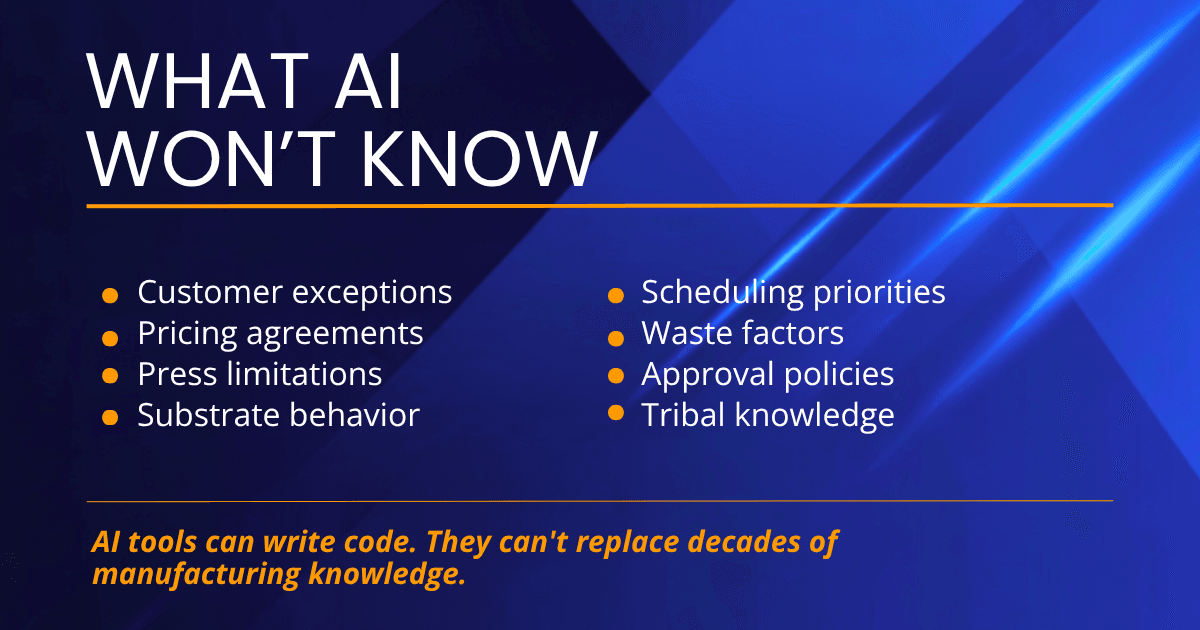
What AI cannot know without being explicitly told —
- Substrate pricing variables by grade, supplier, and contract period
- Gang run logic specific to press configurations and customer approval restrictions
- Waste factors that vary by die configuration, not just job type
- Customer-specific color tolerances that interact with press and substrate combinations
The bottom line: Every AI-generated application that touches business-critical processes should be reviewed, tested, governed, and validated before it becomes part of the operation. And those labor hours must be considered.
The hidden labor hours of DIY AI
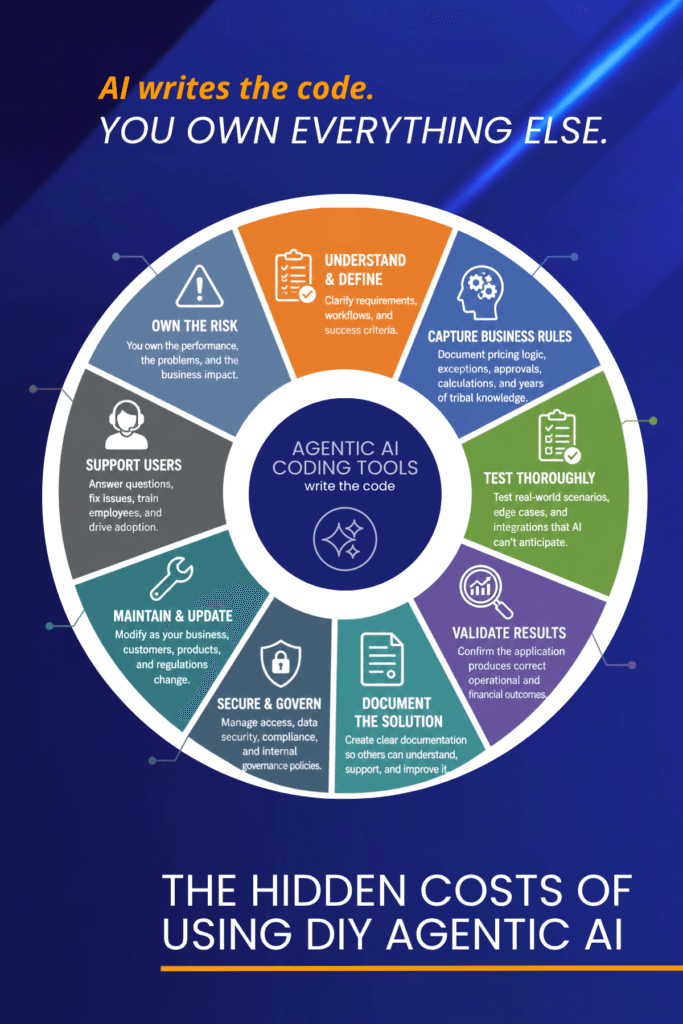
Before trusting AI-generated code in a manufacturing environment, consider the time required to:
- Define all business rules
- Teach AI your operations
- Testing; testing every exception
- Validate the results
- Document the logic
- Secure and protect data
- Maintain the application
- Develop a system to fixing AI-generated code
- Update it as your business changes
The code may be generated in minutes. Confidence in that code is earned through hours of testing, validation, governance, documentation, and ongoing maintenance. Those labor costs should be part of every ROI calculation for DIY AI.
The margin problem: How much to trust DIY AI
Packaging manufacturing runs on margins that leave little room for systemic error. The question isn’t whether AI can automate parts of a workflow. It’s whether you’re prepared to trust AI-generated automation with the decisions that determine your margins: the accuracy, consistency, and operational understanding required when profitability depends on getting thousands of decisions right.
What could happen: A substrate cost miscalculation that rounds incorrectly across high-volume runs. A waste factor that does not account for a specific die configuration. An automated AP entry that misclassifies a materials cost and distorts the job profitability report. An approval step that a workflow script quietly bypasses because the exception condition was never defined. A security issue can emerge, exposing sensitive customer information.
“Among the risks agentic AI poses, “shadow AI” has emerged as a consequence of employees using unauthorized, unsanctioned AI tools or applications. When proper IT oversight or approval gets bypassed, it sets the stage for noncompliance and reputational damage. Departmental AI agents are proliferating without central oversight, creating security hazards and fragmented intelligence.”
–Agentic AI’s crossroads: guardrails or massive fails, Tech Radar
The question is whether DIY AI code runs correctly against the full complexity of the operation — and whether anyone will know the difference before the margin report does.
Who maintains it when it breaks?
The question that most reveals the risk of DIY AI workflow automation in packaging operations: who, exactly, is building these tools?
In most midsize operations, the answer is someone motivated, technically curious, and almost certainly not a trained software developer. A production manager who is skilled with Excel. An IT generalist who handles the network and the printers and now custom AI workflow development. A smart person who watched some tutorials and figured out how to use a coding assistant.
AI coding tools like Claude Code make it easier to create something that works on a good day. The challenge is building one that still works when the unexpected happens—which, in manufacturing, is almost every day.
The difference between a script and a system: The case for decades of experience vs a largely untested tool
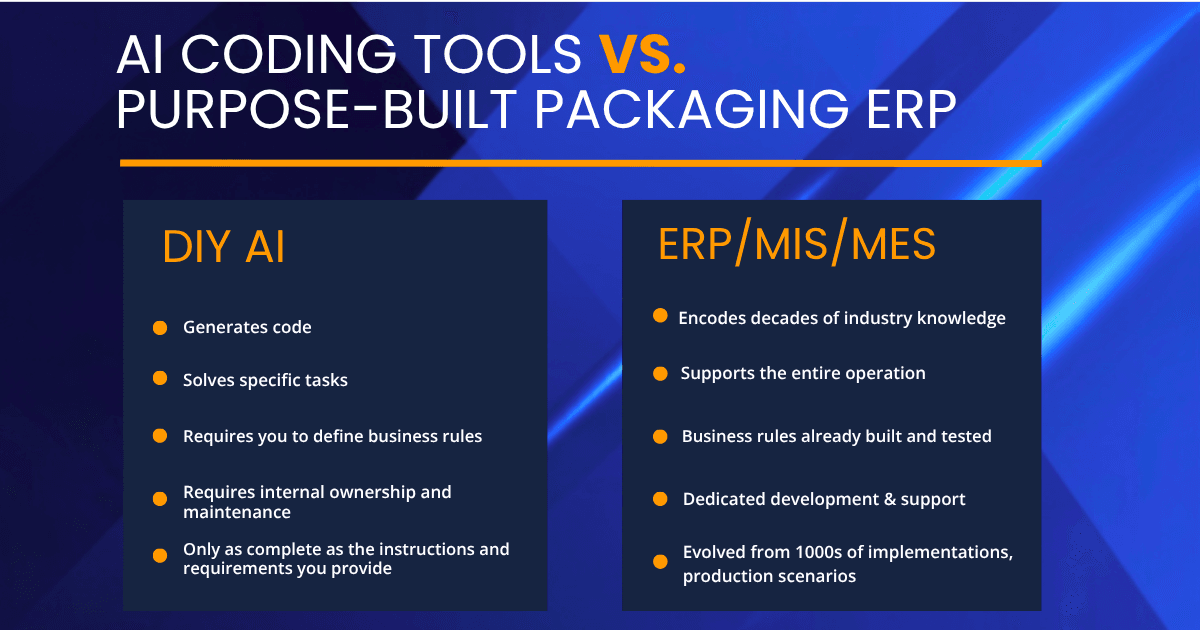
There is a difference between Claude generated code that works, and a comprehensive software system that has been proven to work in packaging specific operations for thousands of customers over time.
A DIY AI tool can produce working code in an afternoon. What it cannot produce is the decade of edge cases that a purpose-built manufacturing software system has already encountered, logged, debugged, and resolved.
Every error condition that a mature ERP handles gracefully — the substrate substitution that triggers a customer approval flag, the job that splits across two press runs and needs cost allocated correctly to each, the invoice that arrives with a line item in a unit of measure the system has never seen from that vendor — represents a moment in the past when that exact scenario occurred in a real plant, caused a real problem, and was fixed by a development team that understood both the software and the industry.
A DIY tool has no such history. It has never met your plant. It has never seen your edge cases. And when it encounters them for the first time — at 2am during a production run, or silently in the background of an AP processing job — there is no development team to call, no support contract to invoke, and no institutional knowledge of what went wrong before and how it was fixed.
Where DIY AI ends and real industry experience begins
Before you build AI applications and workflows it’s worth talking to people who understand both the technology and the realities of running a packaging operation. HiFlow has spent 25 years building solutions for the specific complexities of label, flexible, and packaging manufacturing — not generic business software adapted to fit.
AI coding tools are changing what’s possible. They can build applications, automate repetitive work, and accelerate innovation. But the most successful manufacturers won’t build critical operations on disconnected AI-generated tools alone. They’ll build on a foundation of proven business processes, trusted operational data, and software that has evolved through decades of real-world manufacturing experience.
That’s where a purpose-built packaging ERP becomes more than software. It becomes the operational foundation that gives AI the context it needs to deliver reliable, scalable results.
Because the goal isn’t simply to use AI to automate. It’s to automate correctly.
If you’re exploring AI, workflow automation, or next-generation ERP/MIS, connect with HiFlow to discuss practical approaches that work in the real world of packaging — not just in theory.
Additional articles you might find valuable

Bridging the Gap: Leveraging an ERP/MIS to Mitigate Skilled Labor Shortages
SUMMARY The skilled labor shortage has become a significant challenge across various industries, with sectors like manufacturing, logistics, and packaging feeling the impact most acutely. As the demand for skilled labor continues to outpace supply, organizations are...

Shop Floor Scheduling: Are You Getting the Most out of Your Plant’s Production Capacity?
SUMMARY Summary: SEMrush data from 2024 shows that companies integrating advanced scheduling technologies experience a 25% increase in production efficiency. Getting the most out of your plant’s capacity means implementing a robust ERP that helps plan, execute, and...

Seeing is Believing: Exploring HiFlow’s Highly Visual Workflow
SUMMARY Sometimes it can be difficult to quickly get to a full 360-degree view of the converter’s operation, including both production and business elements. That’s why HiFlow developers have placed a strong focus on developing a highly visual representation of a...