SUMMARY
Everyone is talking about it, trying it out, publishing thought leadership pieces about it, and anxiously or eagerly waiting to see how it will change the world. But do we really know what AI is, exactly? Many don’t.
From estimating and scheduling to purchase order management and analytics, AI is revolutionizing ERP for packaging manufacturing. As software developers, we see firsthand how AI’s capabilities are transforming outdated manual processes into intelligent, automated workflows. This article provides a perspective on you may not have heard before about AI and what it can do for you.
What is AI, really?
It’s important to clarify what we mean by “AI” in this context. We’re not talking about generative AI to create software code or respond to chat questions. We’re focusing on practical applications of AI to collect and analyze data for optimizing manufacturing processes. The good news is that AI and automation tools are becoming increasingly available and affordable, leveling the playing field for SMBs by giving them access to cutting-edge technologies previously enjoyed only by larger enterprises.
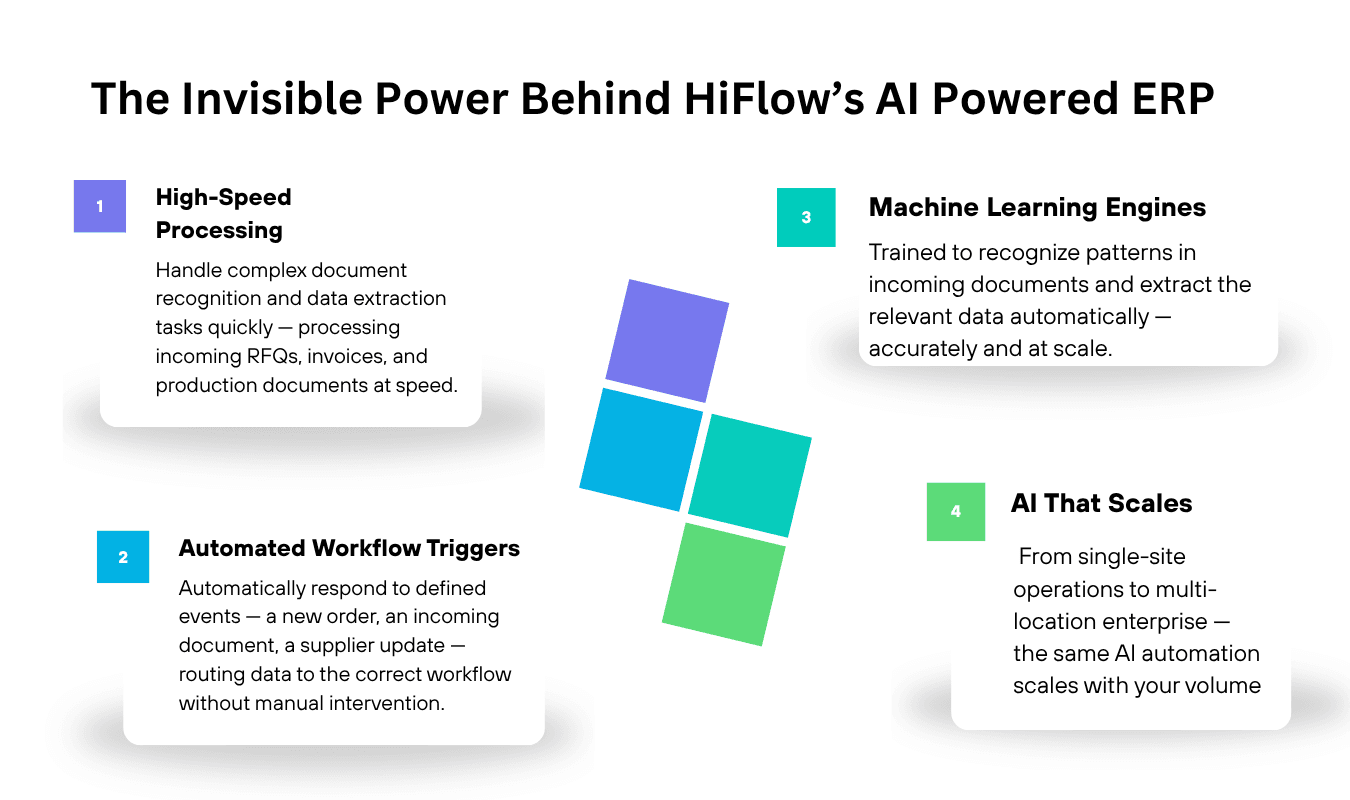
So, if you ask one of us in the technical sphere whether AI has a definition, yes it does. Technically, AI is a pattern-recognition and data-extraction technology — trained to read structured and unstructured inputs, identify relevant information, and populate the correct fields in the HiFlow workflow automatically. It replaces a manual data entry task with an automated one.
When HiFlow refers to AI it means automation powered by machine learning — software trained to recognize patterns in documents and data and extract the right information without human intervention. For example, it reads an incoming RFQ, identifies the relevant specifications, and populates the estimating workflow automatically — the same task a human operator would perform manually, done faster and with greater consistency. The human still reviews, approves, and acts. The AI handles the extraction.
Think of AI in ERP as a data specialist who works at machine speed, never makes a transcription error.
HiFlow is built in layers. Your data lives in one layer. Your business workflows — the rules that move a job from inquiry to invoice — run in another. The AI layer sits alongside both of those, connected to your data and operating within your workflows. What the AI does in that layer is read documents and extract data. An RFQ arrives. The AI reads it, identifies the relevant specifications, and populates the estimating workflow automatically. A bill of lading comes in. The AI extracts the logistics data and routes it to the correct module. A supplier invoice arrives. The AI captures the relevant cost information and feeds it into procurement.
AI performs a specific, trained extraction task — repeatedly, accurately, and at a speed that manual data entry cannot match. The infrastructure behind it runs on Microsoft AI Cloud, which means it is enterprise-grade, scalable, and reliable.
The human is still in the loop at every decision point. The AI handles the data capture so the human can focus on what actually requires judgment — the estimate, the production decision, the customer conversation.
What does AI actually do?
An ERP system might look simple on the surface—dashboards, order screens, reports—but behind the scenes, there’s a powerful network of tools working together to keep everything running smart and smooth. When AI is integrated into an ERP, there’s lots happening under the hood:
- AI is constantly analyzing your business data—things like job orders, inbound logistics, and material usage—to help you make better decisions. It learns from what’s worked in the past and applies it in real time.
- Fast Graphics Processors (GPUs) In packaging and print manufacturing, speed and accuracy are everything. When AI is powered by GPU infrastructure:
- Quotes get out faster.
- Orders are processed without delay.
- Errors are flagged before they become costly.
- Smart Cloud Servers are like the digital engine room. They run the entire system remotely, so you don’t need bulky servers on-site. Everything is fast, secure, and always up to date.
From a Software Developer to the CEO: Why AI Isn’t a Luxury—It’s a Competitive Advantage
As someone who builds and works with ERP systems every day, I can tell you: AI isn’t just a buzzword. It’s a very real, very powerful tool that can help your packaging manufacturing business operate faster, leaner, and smarter. Let me walk you through what that actually looks like—specifically in areas you care about: estimating, procurement, and inbound logistics.
Estimating: From Guesswork to Precision
Estimating used to rely heavily on spreadsheets, tribal knowledge, or rigid rule-based systems. But AI changes the game.
When a request for quote arrives — by email, PDF, or portal submission — HiFlow Quote’s AI reads it immediately. It identifies the relevant estimating parameters — product dimensions, substrate specifications, print requirements, quantities, coatings, finishes, and delivery timelines — and extracts them directly into the estimating workflow without manual re-entry. It also identifies missing information and generates clarification questions automatically, so estimators have complete specifications before pricing begins. The result is a structured, accurate estimate ready for review in seconds rather than hours. The estimator reviews, adjusts, and approves. The AI handles the extraction. Speed and accuracy — without removing the human from the decision.
As a result, your team can generate faster and more accurate quotes, and that means winning more business—especially when customers are comparing vendors. You’re not just throwing out numbers; you’re backing your quotes with real, data-driven intelligence.
Purchase Order Management: Smarter Buying, Less Waste
PO management is usually a manual grind—chasing emails, entering data, hoping you ordered the right amount at the right time. AI changes that.
HiFlow’s AI-powered Purchase Order Processing automates the complete PO intake workflow — from email detection through data extraction, validation, record creation, and production routing. When a purchase order arrives by email, the AI identifies it, extracts header and line item details, validates the information, and automatically imports it into the HiFlow system. PO records are created, documents attached, and acknowledgment communications managed without manual intervention. The order is then routed automatically to the next workflow step — production scheduling, inventory management, or the relevant department. What previously required hours of manual data entry and validation is completed accurately in seconds — at any volume, across any number of supplier relationships.
You’re not just speeding up procurement—you’re reducing over-ordering, avoiding stockouts, and tightening cash flow around materials. And it’s all traceable, secure, and accurate.
FAQs:
A Developer’s Answers Your Questions
on Implementing AI in ERP
1. Is our ERP data secure when we bring in AI?
Yes, and it has to be. From a development standpoint, security is baked into everything we do as developers—especially when we’re dealing with ERP data. Any AI system is built on platforms that follow strict data security protocols, including encryption, role-based access, and continuous monitoring. In our case, HiFlow leverages tools which include enterprise-grade security and regular audits to ensure compliance. So yes, your data stays protected, private, and compliant.
2. Where do we even begin? How do we start bringing AI into our ERP system?
It starts with knowing what you want AI to solve. I always ask leadership to focus on the pain points first:
- Are quotes too slow or inaccurate?
- Are purchase orders processed quickly and reliably?
- Where are losing time due to manual entry?
Once we identify what outcomes you care about—speed, cost savings, accuracy—we can map those to specific AI capabilities (like estimating, predictive scheduling, or smart procurement). From there, we work backward: check the quality of your existing data, clean it up if needed, and then plug in the AI modules that solve real problems—not just theoretical ones.
3. Won’t this be complicated for our team to use?
Not at all. One of the advantages of using AI in a system like HiFlow is that it’s built with usability in mind. The AI features are embedded in the workflows your team already uses. For example:
- Estimators see suggested pricing based on real-time data
- Schedulers get automatic alerts and optimized job sequences
- Production tracking in real time informs all your reports
AI doesn’t sit off in some corner—it’s working in the background, making suggestions, automating routine decisions, and adapting to the user’s role. Yes, there’s a learning curve—but it’s not steep, and we’ll train your team as part of the rollout.
4. What kind of impact can we expect right away?
Even in the first few weeks, you’ll start seeing measurable changes:
- Faster, more consistent quoting
- Streamlined purchase orders without manual re-entry
- Real-time insights into performance and bottlenecks
Long-term, the real value shows up in reduced costs, faster turnarounds, and better decision-making. You’ll go from being reactive to proactive—and that’s what gives you an edge in a competitive market.
5. What’s HiFlow’s role in helping us make this transition?
As your software partner, we do more than just install software—we guide the whole transition. That means:
- Assessing your current systems and identifying AI opportunities
- Creating a clear implementation roadmap
- Helping you organize your data to make it AI-ready
- Training your team and offering support post-launch
We know AI can sound overwhelming, but our job is to make it practical, accessible, and aligned with your business goals. You’re not just adopting AI—you’re unlocking a smarter way to run your operations.
SUMMARY
This article demystifies what AI actually is inside a packaging ERP — and what it is not.
HiFlow’s AI is not an add-on and it is not a separate module bolted onto an existing system. It is embedded directly into the HiFlow platform — automating the high-volume, repetitive data work that has always consumed time and introduced errors at every handoff in a packaging operation. Incoming RFQs extracted and structured automatically. Purchase orders processed from email to production without manual re-entry. Bills of lading separated, validated, and matched to the correct shipping records in seconds. The same accuracy and the same automation — at any volume, across any number of locations, powered by Microsoft AI Cloud infrastructure.
For packaging manufacturers and label converters, this means less time managing data and more time managing the business. Faster quotes. Fewer errors. Complete traceability from inquiry to invoice. And a platform that scales with the operation — without adding headcount or manual process steps as volume grows.
HiFlow is not just a software platform. It is a production partner built for the speed, complexity, and competitive pressure of modern packaging manufacturing.
Ready to see HiFlow’s AI in action? Schedule a walkthrough and see what packaging-specific AI automation looks like inside your operation.
Additional articles you might find valuable

Bridging the Gap: Leveraging an ERP/MIS to Mitigate Skilled Labor Shortages
SUMMARY The skilled labor shortage has become a significant challenge across various industries, with sectors like manufacturing, logistics, and packaging feeling the impact most acutely. As the demand for skilled labor continues to outpace supply, organizations are...

Shop Floor Scheduling: Are You Getting the Most out of Your Plant’s Production Capacity?
SUMMARY Summary: SEMrush data from 2024 shows that companies integrating advanced scheduling technologies experience a 25% increase in production efficiency. Getting the most out of your plant’s capacity means implementing a robust ERP that helps plan, execute, and...

Seeing is Believing: Exploring HiFlow’s Highly Visual Workflow
SUMMARY Sometimes it can be difficult to quickly get to a full 360-degree view of the converter’s operation, including both production and business elements. That’s why HiFlow developers have placed a strong focus on developing a highly visual representation of a...