
What Can Go Wrong When Software Companies Get Acquired
“When ERP vendors are absorbed by larger corporations, customers often lose the innovation, support, and personal attention that made the software valuable in the first place.”
When a company has been running on a legacy system for 20 or 30 years, the risks creep in slowly—and they’re invisible right up until something breaks. It might be a cyber incident, a database corruption, a lack of API connectivity, or simply the fact that the one person who knows how the system works is about to retire.
But there’s another risk that often catches manufacturers off guard: their software provider gets acquired.
Why Software Acquisitions Should Concern You
When ERP vendors are absorbed by larger corporations or private equity firms, customers often lose the innovation, support, and personal attention that made the software valuable in the first place. Here’s what typically happens:
Innovation slows down. Once a company is absorbed, product development often shifts from rapid customer-driven innovation to meeting investor timelines, cost-cutting mandates, or integration requirements. Updates become less frequent and less relevant to your actual needs.

Support quality declines. Experienced support teams who understand your plant, your equipment, and your version history are often replaced with outsourced or centralized call centers. You lose access to the people who truly know your operation.
 Prices increase. Acquired software companies are frequently pushed to raise subscription fees, add maintenance charges, or unbundle features to meet revenue targets. The budget you planned for suddenly doesn’t cover what it used to.
 Customers become “one of thousands.” Roadmaps become dictated by corporate strategy rather than customer needs. The ability to request customizations, integrations, or workflow-specific changes diminishes dramatically. You’re no longer a valued partner—you’re one line item in a portfolio of thousands.
 Talent walks out the door. When founders, original engineers and tech support people leave—as they often do after acquisitions—the deep expertise that made the software effective disappears with them. The relationships you had with the support team disappears. The new team may understand software, but they might not understand packaging — or your company.
 Forced migrations loom. Large acquirers sometimes phase out older versions, force customers into expensive replatforming projects, or consolidate multiple acquired systems into one—disrupting operations and requiring substantial reinvestment.
The most insidious part? Private equity–owned firms typically operate on 3–5 year investment cycles, optimizing for valuation and exit—not for your long-term success. You become a revenue stream, not a partner.
The Questions You Should Be Asking
So how do you protect yourself? By asking much harder questions when evaluating a new software partner—or reassessing your current one.
Don’t just ask what the software can do. Ask questions that reveal whether you’re partnering with a company that will still be there—and still care—five, ten, or twenty years from now.
Critical Questions for Your ERP Provider
Modern IT Architecture
Question 1: Is your system built on a modern, scalable architecture, in a modular configuration, or is it a legacy platform with new features bolted on?
Question 2: How frequently do you release updates—and do they require downtime or manual installs?
Question 3: Can your solution integrate seamlessly with APIs, automation tools, and cloud platforms?
Question 4: How do you handle real-time data flow across estimating, production, inventory, logistics, and finance?
Cybersecurity & Data Protection
Too many legacy systems were built in a pre-cyber-threat era. Make sure your ERP vendor has up to date protocols.
Question 5: What cybersecurity standards and certifications do you maintain?
Question 6: How do you encrypt data for our individual needs?
Question 7: Do you offer multi-factor authentication, role-based permissions, and audit trails?
Question 8: How quickly can your team respond to incidents? How do you respond – in person call or emails?
Data Sovereignty & Control
Your data is your business. You need to know where it lives, who can access it, and whether you can get it back if you need to leave. Asking about data security is vital.
Question 9: Where is my data stored—and who legally controls it?
Question 10: Are you flexible enough to provide both options – on-premises or in the cloud?
Question 11: What happens to my data if we end the relationship or change systems?
Question 12: Do you support hybrid environments (cloud + on-premise) if my organization requires them?
Migration & Implementation
Question 13: What’s your methodology for migrating customers off legacy systems?
Question 14: How do you minimize downtime and disruption during go-live?
Question 15: Do you provide hands-on configuration and process mapping, or is the burden on our internal team?
Question 16: How do you ensure data integrity when importing decades of pricing, SKUs, tooling, BOMs, and customer records?
Training & Change Management
Technology transitions fail more often due to people issues than technical ones. You want a partner who doesn’t just hand you software and walk away, but one who maps your workflows, handles data migration, trains your team, and stays with you until everyone is confident and productive.
Question 17: How do you approach training staff on your ERP who have used the same legacy system for 20+ years?
Question 18: Do you offer ongoing support beyond go-live—or does your involvement end once the system is installed?
Question 19: What tools or methods do you use to monitor user adoption and identify retraining needs?
Question 20: Can your software be configured to match our real workflows, or do we have to change how we work to fit the system?
Long-Term Partnership & Roadmap
These are the questions many manufacturers forget to ask—until it’s too late. Understanding who owns your software provider and what their incentives are tells you everything about the partnership you’re actually entering.
Question 21: How transparent is your roadmap, and how much influence do customers have?
Question 22: Are you independent or controlled by private equity with short-term investment cycles?
Question 23: How do you ensure the system won’t become another “legacy platform” in five years?
Question 24: What’s your company’s ownership structure, and do you have plans to be acquired?
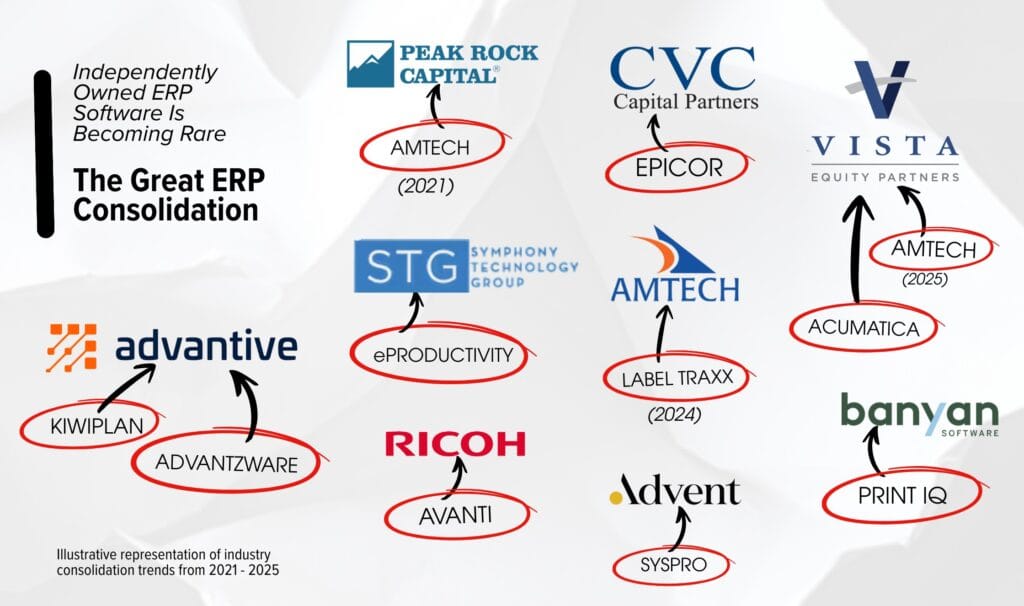
Why Independence Matters: The Value of Family Ownership
Family-owned and independent software companies operate with fundamentally different motivations than those owned by private equity or absorbed into conglomerates. Consider the difference: In HiFlow’s case, when two brothers collaborate to build a company from the ground up, they’re not creating a product to flip in five years—they’re building a family legacy.
That’s the foundation of truly independent software providers, like HiFlow. We’re building for the next generation, not the next quarter. The company becomes something to pass down, to be proud of, to protect. This isn’t just philosophical—it shapes every business decision.
Customer relationships over quarterly targets. When you’re not answering to investors demanding 20% year-over-year growth, you can focus on what actually matters: solving real problems for real customers. Independent companies innovate based on customer needs, not investor demands.
More importantly, independent ERP companies provide personalized support rooted in deep knowledge of your operation. Your support team knows your plant, your equipment, your version history, your workflows, and your goals. When you call with a scheduling issue, they understand your specific press configurations and material constraints. When you need help with a technical question about an estimate, they remember your typical job mix and customer requirements. This isn’t generic technical support—it’s partnership built on institutional knowledge that only comes from years of working together.
That kind of relationship can’t be replicated by outsourced call centers reading from scripts or ticketing systems that route you to whoever’s available.
Independent companies provide this level of personalized service because they can, because they have the freedom to prioritize relationships over efficiency metrics—and because they genuinely care. It’s not required in the contract; it’s embedded in the culture.
Our independence directly shapes our product roadmap. We don’t chase features because investors demand it; we build capabilities because customers need them. When clients tell us they’re struggling with scheduling, or sustainability reporting, or AI adoption, we listen—and then we design solutions that fit real packaging operations. That’s why our modules feel so practical and workflow-oriented. They’re built in collaboration with the people who actually use them.
Long-term technology investment. Being independent means freedom to invest in research and development without having to justify every expense to a board focused on cost optimization. Want to explore AI capabilities for your plant operations? Investigate new integration architectures? Independent companies can move fast because they’re not bogged down by corporate approval processes or forced to align R&D spending with short-term profitability mandates.
Private equity–owned firms often cut R&D first when pressure mounts to improve margins. Family-owned companies can take the long view, knowing that today’s technology investment becomes tomorrow’s competitive advantage for their customers.
Stability you can build on. When a company is family legacy, not an asset to be monetized, customers gain something invaluable: stability. You’re not wondering whether your software provider will be sold, merged, or discontinued. You’re not worried that next year’s contract renewal comes with a 40% price increase because new owners need to “optimize revenue.” You know the people behind the software, and they know you—often for years or decades.
The freedom to say no. Perhaps most importantly, independent companies are not compelled to chase enterprise contracts that pull focus away from mid-size manufacturers. They’re not forced to standardize support to cut costs. They can maintain the hands-on, specialized service that makes complex implementations successful.
When you choose a software partner, you’re not just buying technology—you’re entering a relationship that will shape your operations for decades. Make sure it’s with a company that will still be there, still care, and still innovate alongside you. Make sure it’s with a company that views customers as partners in a shared journey, not revenue streams on a spreadsheet.
Asking the right questions
If you ask these hard questions, you very quickly separate the vendors who have a true modern platform and a real implementation methodology from the ones trying to retrofit old technology or prepare for their next acquisition.
The right software partner doesn’t just provide technology—they provide stability, partnership, and a shared commitment to your long-term success.
Don’t wait until your provider gets acquired to start asking these questions. Ask them now.
About HiFlow
Celebrating 25 years as an independent, family owned software company is meaningful for us because it reflects not just longevity, but the depth of understanding we’ve gained about our customers. We’ve spent two and a half decades embedded in the workflows of packaging, label, and converting plants. We’ve seen firsthand how the industry has evolved—shorter runs, SKU proliferation, automation, sustainability demands—and that history gives us insight you simply can’t buy.
In short, being independent for 25 years hasn’t just influenced our product strategy—it’s defined it. It allows us to build technology with a long-term view, give personalized support that scaled companies often can’t match, and commit ourselves to partnerships measured in decades, not contract cycles. That’s the promise of HiFlow, and it’s one our customers tell us they value deeply.
Evaluating ERP providers for your packaging operation? Make sure you’re asking the right questions about ownership, architecture, and long-term partnership—not just features and price. Book a discovery call with one of HiFlow’s experts who have experience and knowledge of both the packaging industry and technology.
Additional articles you might find valuable

Bridging the Gap: Leveraging an ERP/MIS to Mitigate Skilled Labor Shortages
SUMMARY The skilled labor shortage has become a significant challenge across various industries, with sectors like manufacturing, logistics, and packaging feeling the impact most acutely. As the demand for skilled labor continues to outpace supply, organizations are...

Shop Floor Scheduling: Are You Getting the Most out of Your Plant’s Production Capacity?
SUMMARY Summary: SEMrush data from 2024 shows that companies integrating advanced scheduling technologies experience a 25% increase in production efficiency. Getting the most out of your plant’s capacity means implementing a robust ERP that helps plan, execute, and...

Seeing is Believing: Exploring HiFlow’s Highly Visual Workflow
SUMMARY Sometimes it can be difficult to quickly get to a full 360-degree view of the converter’s operation, including both production and business elements. That’s why HiFlow developers have placed a strong focus on developing a highly visual representation of a...